

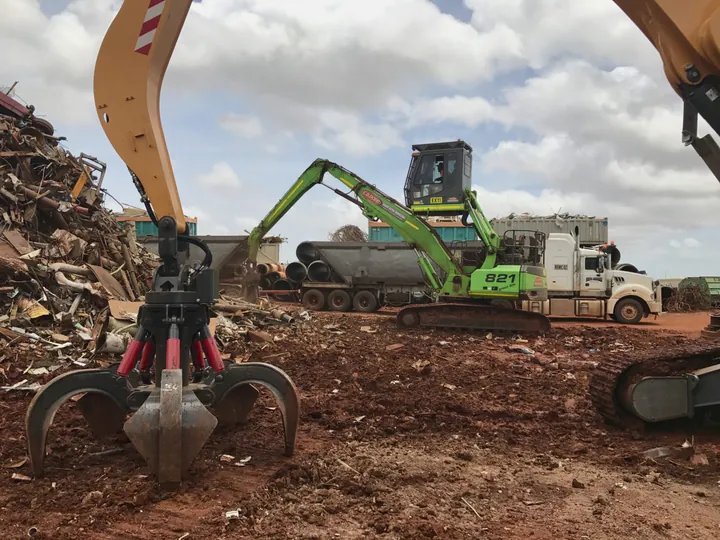

Ageing mine infrastructure – structural steel, conveyors, processing plant, storage tanks and heavy machinery – contains metals that retain value long after they stop producing.
Handled well, that material becomes a revenue stream that offsets the cost of the job. Handled poorly, it goes to landfill, taking disposal budgets and environmental outcomes with it.
Scrap metal recycling is set to play an increasingly important role in modern demolition, supporting safer and more sustainable outcomes across Western Australia’s powerhouse industries.
“Australia has a growing demand for solutions that support the mining industry to optimise the social, environmental and economic outcomes of mine closure and transitions…Australia can leverage domestic mine closure challenges to become a global supplier of solutions that improve outcomes and reduce the costs of mine closure and transitions.”
– CSIRO (2023) Enabling mine closure and transitions: Opportunities for Australian industry
Why Sustainability Matters in Demolition Projects
Australia’s resources and industrial sectors generate significant volumes of waste. And with an estimated 240 mines due for decommissioning by 2040, that volume will only rise.
At the same time, mining and industrial operators are under increasing pressure to demonstrate environmental, social and governance (ESG) outcomes.
Good intentions and collaborative engagement are no longer enough. Stakeholders require evidence that operators are committed to leaving a positive legacy.
Compliance Obligations and License to Operate
WA mining, industrial and demolition projects answer to several State Government bodies:
- The Department of Local Government, Industry Regulation and Safety (LGIRS) for demolition licenses
- The Department of Mines, Petroleum and Exploration (DMPE) for mining operations and shutdowns
- The Department of Water and Environmental Regulation (DWER) for emissions and discharge monitoring, water resources and vegetation
- The Environmental Protection Authority (EPA) for mine closure plans and rehabilitation monitoring
Regulations and oversight are tightening each year. Sustainability is no longer a buzzword; it is now central to operations across all phases of a project.
The Role of Scrap Metal Recycling in Demolition Services
Australia posts strong results in metal recycling and demolition waste recycling. The latest data also shows that commercial and industrial (C&I) waste recycling, which includes mine site demolition materials, has increased in recent years.
- Scrap metal recovery and recycling: 89.9%
- Construction and demolition (C&D) waste recovery and recycling: 81.2%
- Commercial and industrial (C&I) waste recovery and recycling: 58.3%
However, two-thirds of Australia’s metal waste – around 6Mt – is still exported for reprocessing.
There is a significant opportunity for operators and commercial scrap metal recyclers to work together and keep the value of scrap metal from demolition in Australia’s economy.
Recovering Valuable Metals
Steel, copper, aluminium, and stainless steel can all be recycled and repurposed without losing their structural properties. When processed and sorted correctly, the metals recovered from industrial and mine site demolition projects can become a revenue stream that offsets operators’ costs.
Reducing Landfill Waste
Recovering scrap metal from demolition keeps large volumes of industrial waste out of landfills, where the financial and environmental costs climb over time.
Conserving Natural Resources
Every tonne of recovered steel saves an estimated 1.4 tonnes of iron ore, 740 kg of coal and 120 kg of limestone.
Some of those savings are lost when scrap metal is exported. Partnering with locally-owned scrap metal recyclers enables the industry to reinvest in new technologies and processes, increasing our ability to process more and diverse materials onshore.
Effective Scrap Metal Demolition Sorting
Separating materials by alloy and grade upstream is what lifts recovery rates and keeps premium feedstock from being downgraded to commodity scrap.
Safe and Compliant Handling
Tanks, structural steel, processing equipment and machinery can’t simply be torn out. Batteries, oils, hydrocarbons and contaminated materials all require licensed handling and disposal under WA’s Dangerous Goods framework.
These hazardous material handling challenges require the right equipment and approach, including vehicles approved for controlled waste transport and processing facilities capable of safely processing contaminated waste.
Reduced Cost of Demolition Services
Done properly, scrap metal demolition cuts disposal costs at the source. Fewer landfill fees and less expense moving waste off remote sites can make a big dent in mine site demolition budgets.
Access and Rehabilitation
Safe and effective demolition clears the way for rehabilitation works to begin. This is where partnering with a turnkey demolition services provider becomes a strategic advantage.
Here at C.D. Dodd, we not only remove scrap metal for recycling but also handle contaminated soil, hazardous materials like batteries and oils, and even vehicles.
ESG and Scope 3 Reporting
Full chain-of-custody evidence is required for operators to see Scope 3 emissions reductions from scrap metal recycling. There is little to no ESG or Scope 3 reporting benefit without the right documentation, regardless of where the material ends up.
Supporting a Circular Economy
Many scrap metals from demolition projects can be repurposed as new products without consuming more natural resources. These ‘circular economy’ principles align with Federal Government strategies and support local manufacturing, strengthening Australia’s economy and future.
Why WA Companies Partner With C.D. Dodd
C.D. Dodd has spent more than 50 years helping Western Australian businesses solve complex metal recycling, decommissioning and demolition challenges.
As a full-service partner, we provide scrap metal recycling and mine site demolition and decommissioning services across Perth metro and regional Western Australia.
Our team understands the realities of working in mining and industrial environments. Our purpose-built Pilbara facilities and growing Perth recycling operations support a wide range of resource recovery efforts. And our globally recognised certifications demonstrate our commitment to safe, environmentally responsible industrial and mine site demolition.
From infrastructure removal and scrap metal demolition through to transport, processing, recycling and reporting, we help operators reduce risk while maximising recovery.
Working Together to Improve Scrap Metal Recycling Outcomes
Scrap metal recycling is a critical part of sustainable demolition in the mining and industrial sectors.
But it’s only one part. The real value – for operators, communities, the environment and the economy – comes from a continuous improvement approach to decommissioning demolition.
That requires close collaboration between operators with a genuine commitment to ESG outcomes and full-scope scrap metal recycling partners.
Our end-to-end demolition services support your planning and operations at every stage, not just when assets reach the end of their productive lives. This means more efficient and effective scrap material removal, safer handling, less downtime and complete chain-of-custody documentation to support compliance and reporting.
Speak to C.D. Dodd about safer and more sustainable demolition outcomes with expert scrap metal recycling and mine site demolition services.