

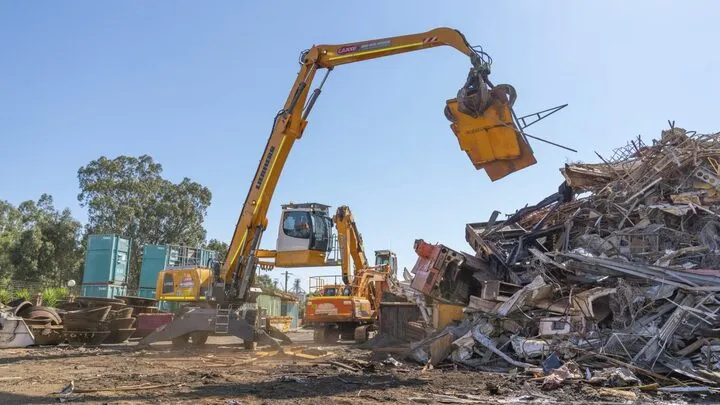

Perth businesses are changing the way they look at scrap metal. Across construction, manufacturing, mining, transport, and the industrial sector, we’re seeing more businesses recognise the benefits of scrap metal recycling.
In part, the change is because sustainability is no longer separate from day-to-day operations. It’s also driven by financial and regulatory factors.
The way materials are purchased, used, and disposed of impacts commercial outcomes as well as sustainability reporting. That’s changing the equation when it comes to commercial metal recycling in Perth.
Why Sustainable Metal Recycling Is On the Radar of Perth Businesses
Metal is Australia’s recycling success story. In 2022-23, we recovered about 90% of the ~6 million tonnes of metal waste we generated. Roughly 84% of that material came from the commercial sector, and metal recycling rates have increased over the last decade in WA.
Businesses across the state are paying more attention to metal recycling. Four factors are driving that change:
1. Responsible Resource Management Expectations
Customers, investors, employees, governments and local communities want to see businesses take practical action to reduce waste and improve environmental outcomes. Statements of intent are no longer enough. Tender panels, investors and major clients increasingly ask for evidence of recovery performance or documented recycling plans.
2. Mandatory Climate Reporting
On 1 July 2026, a new climate-related sustainability reporting standard comes into effect for Australian businesses that meet two of three thresholds:
- $200+ million revenue
- $500+ million gross assets
- 250+ employees
Scope 1 (direct emissions) and Scope 2 (indirect emissions from purchased energy) need to be reported in the first year.
Scope 3 (value chain emissions) reporting becomes mandatory from the second reporting year. Commercial scrap metal recycling directly contributes to Scope 3 emissions reporting.
3. Rising Disposal Costs
The levy for landfill waste in WA is $90 per tonne for 2026/27 ($136 per m3), increasing to $97 by 2029/30 ($147 per m3). Material sent to a licensed commercial metal recycler like C.D. Dodd avoids the levy.
At the same time, sending recoverable materials to landfill makes less commercial sense when scrap metal may have significant market value. Large volumes of clean, high-quality scrap metal, collected on a regular schedule, can be an additional revenue stream.
4. Circular Economy Demand
Recovered steel, copper and aluminium can be recycled into feedstock for the Australian market. As well as reducing emissions – every tonne of scrap used in steel production avoids 1.5 tonnes of CO2 emissions, and recycling aluminium uses 95% less energy than new production – this supports Australia’s circular economy transition targets.
The Business Benefits of Scrap Metal Recycling
Recovered Value and Lower Waste Management Costs
Until recently, the main benefits of scrap metal recycling for Western Australian businesses have been financial. Income from selling scrap, lower waste disposal costs and lower storage costs.
Those are all still in play. A business producing significant scrap metal can recover thousands of dollars per year while avoiding waste disposal costs, adding up to significant bottom-line benefits.
But now there are additional benefits that take commercial scrap metal recycling from a nice bonus to a strategic asset.
Cleaner, Safer Sites
Accumulated scrap doesn’t just take up laydown space. It also restricts personnel access and introduces handling and load-shifting hazards. Regular scheduled collections help maintain cleaner, better-organised workplaces while reducing unnecessary material handling.
This starts with segregating waste as close as possible to the source. Proper scrap metal bins positioned near work areas make it easier for crews to separate and collect scrap metal.
Auditable Sustainability Data
Scrap metal and sustainable battery recycling provide tangible evidence of better resource management. For businesses developing or reviewing sustainability programs – most large-scale operations today – this supports reporting and compliance.
- Scope 3 emissions data
- Weight tickets
- Recycling certificates
- Chain-of-custody records
- Contaminated waste compliance
This is where an integrated waste management partner becomes important. C.D. Dodd manages scrap metal as well as controlled and contaminated waste, including vehicle batteries, hydrocarbon waste, and contaminated soil, enabling businesses to manage all waste streams through one contract.
Where Recoverable Metal Comes From
Almost every commercial and industrial operation in Perth generates metal worth recovering. Not all of it is documented or separated properly.
- Construction: Structural steel, reinforcing bar, fabrication offcuts, copper wiring, aluminium framing
- Manufacturing: Production offcuts, machinery components, redundant plant, tooling
- Mining and resources: Processing equipment, conveyors, pipework, mill balls and liners, drill rods
- Automotive and transport: Engines, vehicle bodies, radiators, wiring looms, lead-acid batteries
- Agriculture: Farm machinery, fencing wire, irrigation pipe, tanks and silos
The volumes, materials and collection requirements differ, but the principle remains the same. Recyclable metal has more value when it is properly separated and managed rather than mixed into general waste.
Building a System That Delivers the Benefits of Scrap Metal Recycling
The key to capturing more of the benefits of scrap metal recycling (with less administrative effort) is a structured program plus the right partner.
- Identify recoverable streams: Map where your operation generates ferrous and non-ferrous metals, cabling, batteries and end-of-life equipment.
- Segregate at the source: Mixed loads are downgraded, meaning we pay less. Separated copper, aluminium and stainless steel attract higher prices, and clean material returns more again.
- Schedule regular collections: Reputable commercial metal recyclers will provide bins, kibble containers, skip crates and roll-on vehicle bins sized to your output.
- Partner with a certified recycler: Look for licensed transport, hazardous material capability and reporting that meets your compliance and ESG obligations.
Good systems should do the opposite of making life more complicated for you and your crews. The right recycling partner will work with you to design a solution around your operations, accounting for heavy equipment, remote locations, large volumes or materials requiring specialist handling.
How C.D. Dodd Supports Perth Businesses
C.D. Dodd has been recovering metal for Western Australian industry for more than 50 years. Today, our commercial scrap metal recycling services support straightforward collection requirements through to complex industrial and mine site projects.
Our collection network extends across Western Australia, including battery collection in regional areas. We have specialised, licensed vehicles operated by experienced teams, and purpose-built processing facilities in Port Hedland, Karratha and Kalgoorlie, as well as our operations in Perth.
We provide tailored recycling solutions, including collection containers and services matched to the scale and requirements of each operation.
Most importantly, safety and sustainability are built into how we work. Our systems, people and equipment allow us to manage challenging recycling projects while maintaining the standards expected by major commercial and industrial operators.
Talk to C.D. Dodd about maximising the benefits of scrap metal recycling with a program built around your operation.